

Time to Go!
What the Ascension of Jesus means for us.

Time to Go!
In many ways, the Apostle Luke was the model of the good journalist. He interviewed the people who knew the important facts about the life of Jesus and wrote a journalistic account, an “orderly account” of Jesus’ life – and the important events that happened over the next few decades. Let’s understand this important Gospel writer.
Luke, as far as we know, never met Jesus personally. Luke wasn’t even Jewish, but was instead raised and educated as a Greek. But Luke eventually traveled with Paul and met and interviewed all the right people, giving us the most complete account of the life of Jesus, as well as the events after the Resurrection, particularly following Peter and Paul through key events. We can imagine Luke taking notes from his talks with the disciples – and so he attempted to write an “orderly account” of the Jesus movement. We owe Luke much, for his two writings, Luke and Acts, represent over a quarter of the New Testament.
Luke was born a gentile, not Jewish, and likely lived in Antioch in Syria, which is where he probably first heard the Gospel, since Paul, Barnabas, and others were teaching there for several years. But Luke doesn’t appear until later in the Book of Acts.
We find that Luke joins up with Paul when Paul came to Troas, a bustling port city about 20 miles south of ancient Troy in NW Turkey, near the southern entrance to the Sea of Marmara. In Acts 16, Luke suddenly shifts from speaking about Paul and his companions in the 3rd person, to suddenly speaking in first person. Look at verses 8-10:
8 So they passed by Mysia and went down to Troas. 9 During the night Paul had a vision of a man of Macedonia standing and begging him, “Come over to Macedonia and help us.” 10 After Paul had seen the vision, we got ready at once to leave for Macedonia, concluding that God had called us to preach the gospel to them.”
Notice that Luke has now shifted to using the word “we” to describe the group, indicating that Luke is now a member of the group. Scholars have found that Luke was the only Gospel writer who was not Jewish, trained as a physician and highly educated in Greek literature and joining Paul in his mission as Paul crossed over into modern Greece. And Luke stuck with Paul. Near the end of Paul’s life, when he is a prisoner in Rome, Paul writes to Timothy that “Only Luke is with me.”
Traditionally, Luke wrote both the Gospel of Luke and the Book of Acts. He apparently had access to and interviewed key people such as Paul, Peter, Mary the mother of Jesus, and James the brother of Jesus, as well as most of the other disciples. His Greek is very polished. Luke died at age 84 and his tomb was in the Greek city of Thebes, but his body was transferred to Constantinople in 357.
And so Luke speaks to us today about the last days of Jesus on the earth, both in the 24th chapter of the Gospel of Luke – and in the first chapter of the Book of Acts.
After the Resurrection, Jesus appeared to various people, different groups at different times and places, including once where, according to Paul, over 500 people were present. Over 500 people witnessed the resurrected Jesus!
After forty days of these appearances, speaking and teaching and eating with the disciples, Jesus led them out of Jerusalem to the Mount of Olives near Bethany, and was taken up into Heaven.
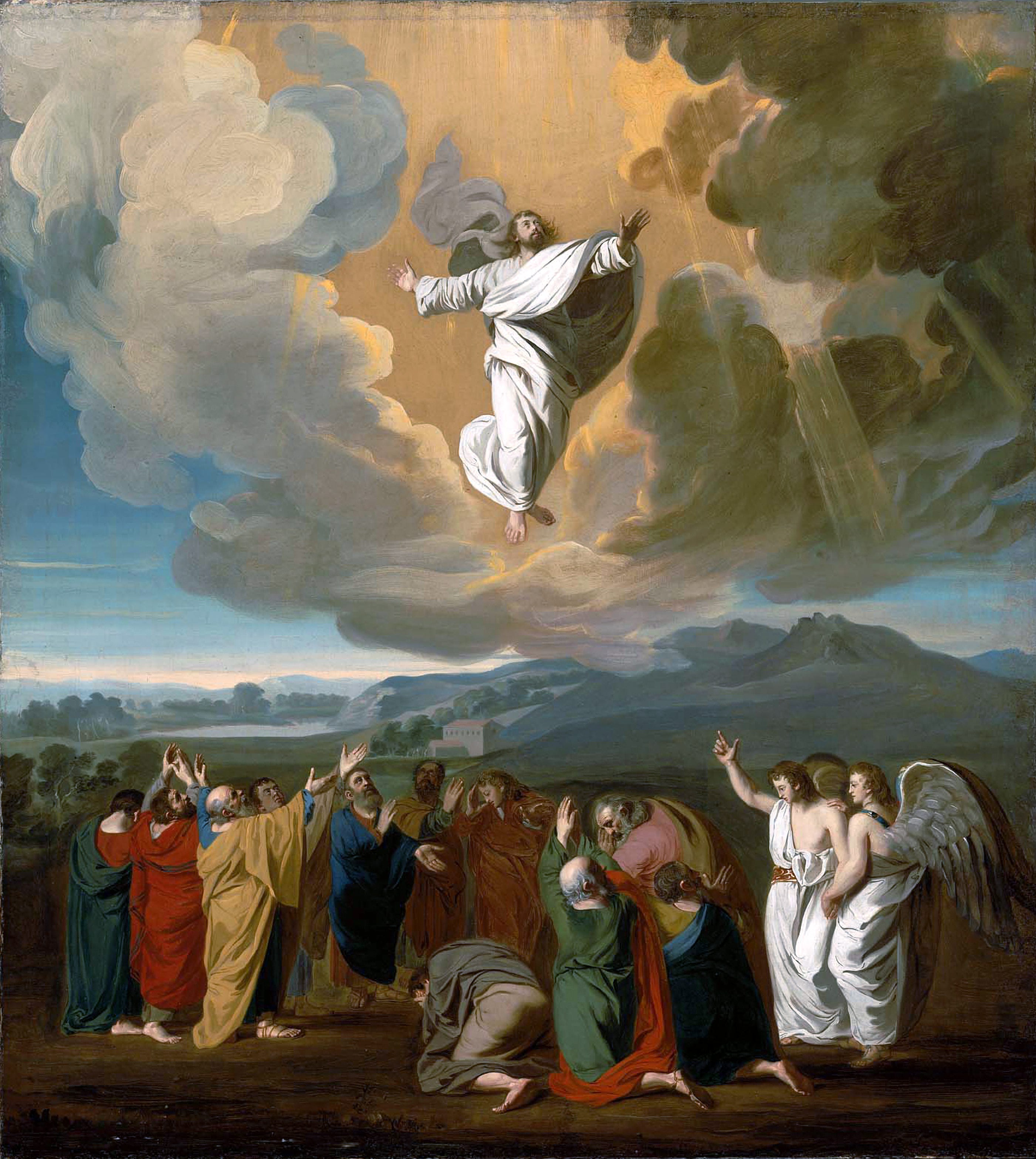
The Ascension of Jesus is something which we don’t give enough attention to, for it gives us great insight into our role in the spread of the Gospel.
I want you to imagine for a while that Jesus did not ascend to Heaven, but chose to stay with the disciples. What would have happened?
First of all, we have to keep in mind that while on earth Jesus was limited by the constraints of a human body, the principle problem being that Jesus’ body could only be in one place at a time. But if Jesus stayed on earth, we can imagine a new encounter with the rulers of Jerusalem, both Jewish and Roman, and a renewed attempt to kill Jesus. After all, the leaders of Jerusalem plotted to kill poor Lazarus after Jesus brought the man back from death = ad Lazarus was no where near the political figure that Jesus was!
And then, we must assume that Jesus would defeat His enemies, for another death and Resurrection would be pointless – and a permanent death would accomplish nothing. And so we settle into centuries where an immortal Jesus sits on a throne in Jerusalem, teaching and acting as a benevolent judge. Over time, His fame spreads across the earth and people come to visit him. So what’s the problem?
Jesus can only be in one place at a time. Outside of His line-of-sight, people will still do what they’ve always done – squabble, complain, backstab, fight, and generally do evil to one another. Nobody could seriously challenge Jesus’ rule – after all, we assume that He is supported by an angelic army - but His rule is limited by the reach of His arm.
And now we can begin to understand the purpose of Jesus returning to Heaven.
Jesus makes it clear that He is sending the Holy Spirit to the disciples to guide them and to be passed onto others. And the Holy Spirit can spread from one disciple to the next. It is like a benevolent virus that is passed from person to person. Let me explain.
We think of viruses as causes of disease. But modern geneticists are beginning to use viruses as ways to cure certain genetic diseases like Huntington’s, cystic fibrosis, Duchenne Muscular Dystrophy (DMD), and even certain types of Hemophilia. A “good” gene is attached to a virus, which then infects the person and swaps out the good gene for the bad gene. After the infection runs its course, the person is cured of the original disease, with the good genes now producing what was lacking in the original body.
And this is much the same as when the Holy Spirit swaps out a bad spirit for a good spirit, moving from person to person, changing their hearts from selfishness to selflessness. And the neat thing about this approach is that over the centuries, the hearts of over a billion people have been changed from evil to good. The Holy Spirit replaces what was lacking in our original souls and hearts – the direct connection with God.
If Jesus had remained on earth, He could only have acted on those people in His presence. But because Jesus returned to Heaven and sent the Holy Spirit, the Holy Spirit has spread and changed people all over the earth. It is a fantastic way to eventually “infect” the entire world with goodness.
The Holy Spirit was so critical that Jesus told the disciples to wait in Jerusalem until they were baptized with the Spirit. They were not to go out on their own, but they needed the guidance of the Holy Spirit.
Have you also considered why Jesus didn’t just call down angels to defeat His enemies and conquer the earth? Why didn’t He just destroy those enemies?
Consider this: Every time a person is converted, a person goes from being an enemy of Jesus – like the young man Saul was – and becomes an ally of Jesus – like Saul became as he became known as Paul the Apostle.
Look at the great change that happened in Saul. As a young man, he stood holding the cloaks of men who threw stones to kill Stephen. Over the next months he went house to house with guards, dragging Christians off to prison. He absolutely hated the idea of the worship of Jesus, considering it the height of blasphemy. And then, after meeting Jesus on the Road to Damascus, Saul’s tune totally changed. Listen to his letter to the Ephesians, Chapter One to see how much Saul changed as he went to the Romans and Greeks around him, using the name Paul:
15 For this reason, ever since I heard about your faith in the Lord Jesus and your love for all God’s people, 16 I have not stopped giving thanks for you, remembering you in my prayers. 17 I keep asking that the God of our Lord Jesus Christ, the glorious Father, may give you the Spirit of wisdom and revelation, so that you may know him better. 18 I pray that the eyes of your heart may be enlightened in order that you may know the hope to which he has called you, the riches of his glorious inheritance in his holy people, 19 and his incomparably great power for us who believe. That power is the same as the mighty strength 20 he exerted when he raised Christ from the dead and seated him at his right hand in the heavenly realms, 21 far above all rule and authority, power and dominion, and every name that is invoked, not only in the present age but also in the one to come. 22 And God placed all things under his feet and appointed him to be head over everything for the church, 23 which is his body, the fullness of him who fills everything in every way.
It is clear that by the time Paul wrote this letter, Paul absolutely worshipped Jesus and considered Him to be Paul’s Lord, directly connected to God.
This is one reason that it really bothers me when some radio show and podcast hosts talk about “defeating the enemies of Jesus”. They like to attract listeners, and so they want to win debates and destroy their debate opponents. But look at what happens when you win a debate, defeating the opponent as these people suggest:
Before the debate, there were two people, one of whom was on Team Jesus and the other was on Team Devil. If the Team Jesus debater destroys his opponent, embarrassing him, sarcastically demolishing his arguments, the Team Devil opponent has lost publicly. But after that debate, there is still only one person on Team Jesus and now there is a tougher, wiser, revenge-seeking member of Team Devil. And depending upon how many people were listening and watching, and the tactics used by the Team Jesus debater, there is likely to be a split among those spectators as to which team they want to join. After all, most people don’t want to be associated with an arrogant person, even if that person “wins” the debate.
But if the Team Jesus debater is gentle, holding a loving conversation and focusing upon conversion rather than upon winning, at the end of the conversation, there may now be two members of Team Jesus and no members of Team Devil. The former member of Team Devil will now be an ally of Christ. And the spectators will be much more likely to lean toward Team Jesus for they have heard the facts and, more importantly, seen the love that Team Jesus has for our enemies.
We are not asked to defend Jesus and defeat His enemies. He doesn’t need anybody to help with that. They killed Him once and see how far that got them!
Instead, we are asked to find people and lead them to Jesus. Even converting people isn’t even our responsibility. No, that is the responsibility of the Holy Spirit. Our responsibility is to find people – all sorts of people – and bring them to baptism, then teaching them everything that Jesus has commanded.
So are we to speak with people about Jesus - or not? Sometimes it seems like we are to work very hard to convert people and sometimes it seems like we aren’t. What are we supposed to do?
Let me see if I can clarify this a bit more.
When it comes down to it, Christian maturity comes as we learn more and more to let God control our lives. It isn’t about learning more and more facts about Jesus’ life, about the New Testament, about the Old Testament. That helps in many ways, but that is only part of the picture, a strategy, not the goal. The goal is to trust God so much that we only want what God wants. Theologians call this complete sanctification or Christian perfection. John Wesley wrote an excellent explanation of this. And sanctification only comes with our increasing trust in God, our increasing faith in Him. Which usually takes time. Years and decades.
Today, for example, we may learn to stop worrying about the outcome of a particular event, like whether or not we will make a particular sale or whether or not our sick dog is going to survive. We show our faith in God’s goodness when we can truly walk into the situation and say, “God, whichever way it goes, I’m good. I’m leaving it up to you because I know you love me, are wiser than me, and are good. God, You can make a much better decision than I can and so I trust You.”
And then tomorrow, we have another test situation which allows us another chance to stop worrying and let God handle that situation, too. And so on, day after day, we can build our trust and faith in God by letting go and letting God decide what’s best for us and then looking back at how God’s answer was so much better than our plan. We have to learn to give God that permission to decide for us, rather than insisting that we know the best answer. Because we don’t. God does. But we have to give God permission to take over things in our lives. For God is so wise and polite that He is very willing to let us make poor decisions by ourselves so we will eventually learn that His way is best – not our way. God plays for eternal victory.
And the eternal victory is won when we finally understand that God’s answer is always better than our answer. When we finally get that through our stubborn minds and deep into our stubborn hearts, we can truly begin to worship God for the good, loving God that He is.
Why do we resist? Because admitting that God is wiser and loving means admitting that there is Someone we should bow to. And deep down, we don’t want to bow to anyone.
This technique of letting go works with evangelism, too.
What most people don’t realize is that we don’t do evangelism successfully. Instead, to be successful at evangelism, we must give God permission to do evangelism through us.
The first step is with our morning prayers. Consider praying something like this: “God, please send me people who need to hear about Your love. And give me the bold words to say that You want said.” And then go about your day.
Most people who do this at first are always still trying to second-guess God. “God, is THIS the person you want me to talk to today, or is it THAT person over there?” We keep wanting to make those decisions. We think we are more important than we really are.
Instead, the best thing to do is just sit back and say “hello” to anyone who is close by. It doesn’t matter whether you are at a baseball game, at the supermarket, or in the library. It doesn’t matter if you’re waiting for a bus, riding a bus, or walking in your front yard. And it certainly doesn’t matter whether the person you’re talking to is rich, poor, old, or young. Just trust in God, be open and friendly to everyone you meet, and God will send you the person who He needs you to talk to.
And when the conversation starts, mention God or Christ in some manner. Observe the person’s response. And let the Holy Spirit guide your responses. Pray under your breath – “What should I say now?” and listen – to the Spirit and to the person. Let the person ask you questions. Don’t try to guide the conversation too much. Let it flow naturally and the Spirit will guide it.
Remember: Our goal isn’t to invite someone to church. We don’t get off that easily. Our goal is to lead someone to Christ. And that takes time.
Imagine you walked into a car dealership, looking to have the A/C fixed on your existing car. A salesperson meets you and asks you right up front: “Why don’t you come into my office and buy our top-of-the-line car today? I’ve got the paperwork all ready.” You’d back off, wouldn’t you? Of course! You just wanted your A/C fixed, after all.
We need to find out what’s on the mind of our new friend, what’s bothering them in life, something about them. They need to understand that we have the answers to their problems before we can lead them to buy Jesus today. That can take months of developing a relationship where they consider us to be their wisest friend. And then, we can guide them to Jesus.
Often, our God-given purpose today is simply to remind them that there are nice, wise people who love Jesus out there. And that we are one of those people.
Imagine that there is a dial on the heart of everyone you meet. At one extreme there are those bitter, angry people who hate everybody. Their dial is set to zero. But there are also those angelic, committed, and mature Christians whose dial is set at 99 or 100. Everyone else’s dial is somewhere in between those extremes. And a person needs to get to about 80 before they have any interest in coming to church.
Our goal is to move that dial one or two points in the good direction with every time we meet and talk with other people. When they get to about 70, we can start having real heart-to-heart talks about Jesus. But even then, they still have aways to go before they’ll want to come to church. And after they start coming to church, we can talk about baptism. It all takes time. Have patience!
Just before Jesus said it was time for Him to go, He told His disciples to get together in Jerusalem and wait for the Holy Spirit. He knew that the disciples – and the disciples of the disciples – and us - would need to carry His teachings and the Holy Spirit around the world to really bring the Kingdom of God to earth, because all those people needed the dials on their hearts changed. Changing the hearts of people over the centuries was necessary before the Kingdom of God could take over the world. And that would take time.
The entire reason for the death and Resurrection of Jesus was to give His words credibility. We needed to understand that His teachings about how to live life were backed up by a knowledge of how to live again eternally, otherwise, Jesus’ teachings would fade into the background noise of a hundred thousand gurus and teachers.
But you know that He rose from the dead. And that means that as a disciple you really need to get serious about what Jesus said. My half hour talks and writings once a week aren’t enough.
When was the last time you read through the New Testament on your own? It isn’t that long a book? Grab a modern, easy-to-read translation like the NIV or the NKJV or the Holman and read the entire New Testament this summer.
When was the last time you read passages from the New Testament to your children, your grandchildren, or your spouse? Let it become a regular part of your day.
Jesus told His disciples to be witnesses of His teaching, death, and Resurrection. And He promised that we would be clothed with power from on high. And then it was time for Him to go, leaving it up to us.
And so we need to learn His story, His teachings, His commands to us so we can truly follow Him. The more we learn about Him, the more we will be able to trust Him in everything, the more we can follow Him.
Or do you have more important things to do before it is time for YOU to go?
Amen